
Schubert
Why it matters
Schubert’s music invites listeners into an intimate, acoustic world that rewards focused attention and quiet reflection.
Read moreRead less
Often described as having an acoustic small-group texture, Schubert’s compositions create a soundscape that feels both personal and nuanced. This quality makes his work especially suited to moments of focused listening, where each note and phrase can be fully appreciated.
While Schubert himself is not directly credited on the 1959 Boston Symphony Orchestra recording of Symphony In C Major "The Great," this release highlights the era’s dedication to classical composers and their enduring influence. It’s a reminder of the rich musical landscape into which Schubert’s works fit, even as interpretations continue to evolve.
-
VINTAGE VINYL

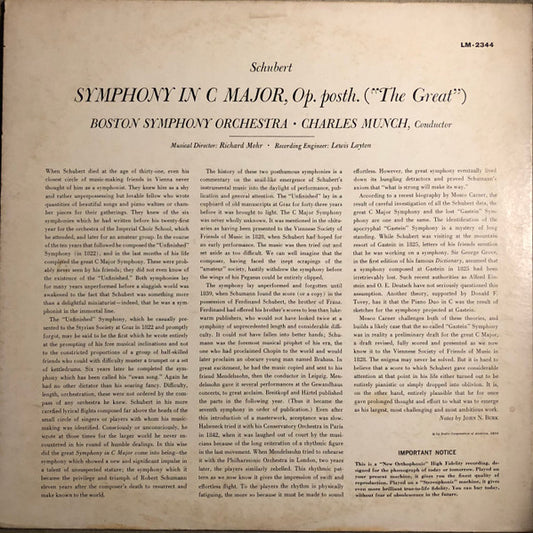
Schubert - Boston Symphony Orchestra, Charles Munch - Symphony In C Major "The Great" - LP
VG+ / VG+ 1959Regular price $10.00 USDRegular price

3 Things You Need To Know
Classical Symphony Essentials
Schubert's music shines in large-scale symphonic works like his Symphony In C Major, often called "The Great," which is a cornerstone for exploring his orchestral output.
Acoustic Small-Group Texture
His compositions frequently feature an intimate acoustic small-group texture, perfect for listeners who appreciate detailed, focused listening experiences.
Ideal For Focused Listening
Schubert’s works tend toward music that rewards concentrated attention, making his pieces ideal for deep listening sessions where every nuance matters.

Schubert Vinyl Records For Sale
Discover New Music
-

🎧 Doomscroll Our Inventory
DenTok (get it?) is our scroll and listen discovery app. Scroll up to move to the next album, or scroll left to find the next song in an album. Want to save a song for later? Double-tap or tap the heart icon to add it to your Wishlist. Expect to hear plenty of your favorites, some hidden gems, plus a few surprises!
-

⚡Flip Through Records Quickly
Flip through records at lightning speed. Swipe left to pass, swipe right to save to your wishlist. You'll see plenty of albums we think you'll love — plus a few unexpected picks to keep things interesting.

